
 Connect Sign In



Human-Centered Automation Systems: Built for Our People, Patients, and Clients
ARUP Laboratories has been investing in automation since the 1990s, using technology to improve efficiency, reduce errors, and improve turnaround times for patients. Automation has long supported ARUP’s growth strategy, but the approach today looks different for one of the nation’s most highly automated labs.
Automation projects underway at ARUP aim to significantly reduce hands-on time and improve quality.
“In the past, we thought, automate, automate, automate,” said Adam Barker, PhD, chief operations officer and president of the Reference Business Unit at ARUP. “Now, we’re very intentional. Every project is evaluated with our Improvement Engineering and Automation teams to ensure the workflow makes us more efficient and improves patient care.”
That shift reflects ARUP’s move toward automation that works alongside people.
“Instead of removing humans from the process, we’re designing systems that include them,” Barker said.
One system currently in development is Robotic-Assisted Processing (RAP). Used in Specimen Processing, RAP combines robotics, artificial intelligence (AI), and human expertise to dramatically increase throughput. The system uses AI to identify patient information on paperwork and specimen labels, tasks that would otherwise require careful, time-consuming manual review.
“Fully automating Specimen Processing would be challenging for ARUP because we accept so many diverse specimen and tube types,” Barker said.
That flexibility is a point of pride, according to Zach Wilkey, MLS(ASCP)CM, operations director of Support Services, who oversees automation initiatives together with Barker.
“ARUP prides itself on being able to accept nearly any specimen from our clients,” Wilkey said. “We design automation around multiple tube types, sample types, temperatures, and other variances. We handle the exceptions so our client hospitals and laboratories don’t have to.”
Additional automation projects are underway across ARUP. One example is automated RNA extraction, which Wilkey described as a potential game changer for ARUP’s molecular labs. Currently, it takes technologists several hours to prepare samples for RNA extraction. By applying automated liquid-handling techniques, Wilkey’s teams aim to significantly reduce hands-on time and improve quality by reducing human touches.
Moving specimens quickly and safely through ARUP’s more than 70 labs and multiple buildings is another priority. An expanded fleet of autonomous mobile robots (AMRs) is part of that strategy. Depending on the use case, AMRs might transport specimens at specific temperatures, deliver supplies, or move large totes. In the future, AMRs may even travel between some of ARUP’s nine buildings in the University of Utah’s Research Park.
As each automation project is evaluated, Wilkey emphasized that technology is a means, not the mission, and patient care remains central. He added that automation at ARUP is more than machines and robotics.
“It’s an ecosystem of technology, thoughtfully designed workflows, and people working together to support patient care,” Wilkey said.


Milestones in ARUP Automation
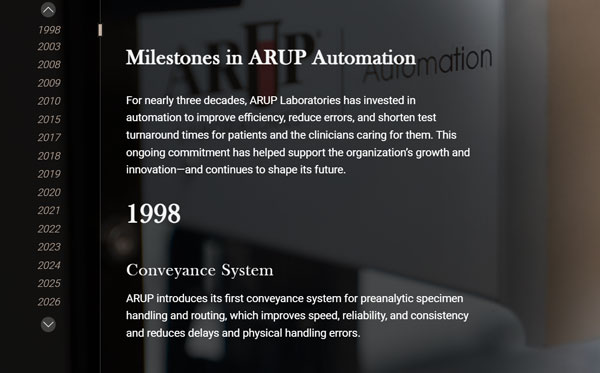
For nearly three decades, ARUP Laboratories has invested in automation to improve efficiency, reduce errors, and shorten test turnaround times for patients and the clinicians caring for them. This ongoing commitment has helped support the organization’s growth and innovation—and continues to shape its future. ... See the timeline
